Pages

Wednesday, December 24, 2025

Rhythm & Broken Rhythm

Broken rhythm is the strategic disruption of your own timing and movement patterns to confuse an opponent, with the goal of making your attacks harder to defend. 

Rhythm and broken rhythm are concepts that heavily borrow from music theory. In music, a standard rhythm is counted one-and-two-and-three-and-four. "One-and" is one whole beat. The "and" between one and two is referred to as the half beat. 

I'll use a simple example to demonstrate how this concept can be applied to striking. Imagine attacking with a jab, cross, jab, cross combination in a steady rhythm. Broken rhythm can be applied to this combination by either speeding up or slowing down (pausing) your movements. For instance, you could:

Jab (pause), cross, jab, cross 
Jab, cross (pause), jab, cross
Jab (slow), cross (slow), jab (fast), cross (fast)

The last combination provides an example of hitting on the half beat. The first jab, cross, establishes the rhythm and the second jab is thrown much faster so that you hit on the "and" between the two and what would normally be three. 

Various Applications of Broken Rhythm
While the example above illustrates how to break the rhythm of a specific attack combination, the concept itself has broader applications. It is not limited to just the speed of your punches; it can be applied to the interaction between you and your opponent as a whole. Generally, broken rhythm is applied in three distinct dimensions of the fight:

1. Breaking the Rhythm of Your Attack As shown in the jab-cross example, this is about disrupting the rhythm of your offensive output. If you attack with a monotonous cadence, the opponent’s brain will naturally adapt to the pattern and time a block. By applying broken rhythm—specifically by hitting on the half-beat or the "&"—you bypass their sensory processing. You are landing the second strike while their brain is still calculating the rhythm of the first.

2. Breaking the Rhythm of the Opponent’s Attack (Interception) This is the defensive application of the concept. Just as you have a rhythm, so does your opponent. If they attack with a "one-two" cadence, a standard defense would be to block on "one" and counter on "two."

In Jeet Kune Do, you can apply broken rhythm by refusing to wait for the "two." Instead, you can intercept. You break their rhythm by striking during their beat. This means attacking at sometime during an opponents strike but before it's recovery (See Counter Attack)

3. Breaking the Rhythm of Footwork See JKD The Arsenal of Self Expression


https://www.youtube.com/watch?v=yZU0R38EEpY

chrome-extension://efaidnbmnnnibpcajpcglclefindmkaj/https://www.dojochattanooga.com/uploads/6/2/1/2/6212730/fencing_thesis.pdf

https://brucelee.com/podcast-blog/2018/3/21/90-broken-rhythm

https://www.youtube.com/watch?v=HkdTxfIZA9I

Tuesday, December 23, 2025

Gazelle Step

The gazelle step is an explosive leaping footwork technique used to deliver a lead hand strike. 

To execute, you lean forward, shifting weight onto the front foot, almost as if you were feinting a cross. From there you push off the floor with both feet, but primarily the lead leg, propelling yourself forward and slightly upward (hence the "Gazelle" name).

The gazelle step can be very deceptive as it deviates from standard forward footwork methods (push step, step and slide) and is executed from a position from which you wouldn't expect a fighter to be able to quickly cover much distance. 

Gazelle step technique example


Corkscrew uppercut using the gazelle step


*McGregor's corkscrew uppercut
*Prince Naseem: The Southpaw Blitz Corkscrew Into Cross


Slip to Lead Side to Angled Gazelle Step

Friday, December 12, 2025

Hand Immobilization Attack

Hand immobilization attacks involve clearing or pinning an opponent's arm in order to open a line to strike them. This is often referred to as trapping hands. 

When speaking of hand immobilizations, there a generally an understanding of what it refers to, though its distinction from striking within the clinch is often unclear. To address this ambiguity, I’ll add some further clarification. Hand Immobilization Attack (HIA), or trapping, focuses on immobilizing or manipulating an opponent’s arms to create openings for strikes. Clinching, by contrast, is broader in scope and centers on controlling an opponent’s head, neck, or torso to off-balance them or maintain positional control.

Within Bruce Lee’s Five Methods of Attack, the concept of hand immobilization as a distinct category can be traced to his early training in Wing Chun. This martial art places a heavy emphasis on close quarters fighting where, through arm to arm contact with your opponent, you learn to feel how they are pressing against you (feel their energy) and manipulate their arms in order to successfully strike them. 

Though this was a core aspects of Lee's early training, evidence suggests that he was gradually moving away from it as he developed his system. Many accounts suggest that his fight with Wong Jack Man marked a pivotal shift in his approach to combat. 

Modern mixed martial arts seem to validate Lee’s decision to downplay the Hand Immobilization Attack. In actual fights—whether in sport competition or real-world encounters—multi-stage trapping sequences are virtually nonexistent. Even simple traps appear infrequently, and when they do, they rarely resemble the techniques most emphasized in traditional Wing Chun practice.

That being said, there are clear examples of HIA performed successfully in combat sports. In this section I highlight some of those techniques.


Lead Arm Inside Hand Pull Opp. Lead Arm(Jut Sau)
-To Rear Hand Punch  -To Rear Hand Punch 

Lead Arm Outside Hand Pull Opp. Lead Arm (Lap Sau)
-To Rear Hand Punch -To Rear Hand Punch
-To Rear Elbow

Rear Arm Outside Hand Pull Opp. Lead Arm (Jut or Pak Sau)

Rear Arm Outside Hand Pull Opp. Rear Arm (Lap Sau)

Lead Arm Outside Hand  Pull Opp. Rear Arm

Double Outside Hand Pull To Knee

Unmatched Stance
Lead Arm Outside Hand Pull Opp. Lead Arm

Tuesday, December 2, 2025

Catching Round Kicks to the Body

Over Catch 
Lead Side Step Off & Over Catch *example

Rear Side Step Off & Over Catch 
(be cautious of this as you are potentially exposing's yourself to a liver shot)


Under (Shelf) Catch 
Lead Side Block & Under Catch *example


Rear Side Block & Under Catch *example


Scoop Catch to Scoop
Similar to the scooping parry used against straight kicks to the body. Catch the kick off of a Dutch block, then redirect the leg. 

Lead Side Sweeping Catch

Rear Side Sweeping Catch *example


Monday, November 10, 2025

Miscellaneous Defense

I. Rolling With Strikes
"Rolling with the punch", or in a broader sense, rolling with the strike, is a reactive defensive movement that involves moving your body in the same direction as the incoming force at the moment of impact. The goal is not to entirely miss the strike, but to minimize the damage by extending the time over which the impact occurs. Instead of creating a hard, sudden stop (like a car hitting a brick wall), your body acts more like an air mattress—it "gives" to the force. This movement dissipates the punch's energy over a greater distance, preventing a jarring, sudden shock.

"Rolling means nullifying the force of a blow by moving the body with the blow. Against a straight blow, the movement is backward; against hooks, to either side; and against uppercuts, it is backward and
away." Haislet

Anyone that has played a little baseball has probably experienced this concept. Imagine you catch a hardball in your gloved hand. If you catch it firm, with a stiff hand, you feel the full force and it stings your hand. If you catch it and pull your arm gback as it hits your palms, you absorb the force over a longer distance and feel less or no sting. 

I distinguish two types of rolling with strikes. 1) Rolling when hit 2) Rolling with defensive tool

1) Rolling when hit
For example, your guard is down and you are hit directly in the side of your face. However, you manage to turn your head at the same moment of impact, moving with the momentum of the punch.

2) Rolling with defensive tool
Example, you see your opponent throw a hook toward your head, so you cover your head with your arm (use a side cover) and simultaneously roll your torso and neck in the direction of the incoming punch

This technique is a cornerstone of defensive boxing, allowing a fighter to "take" a punch without suffering its full consequences, maintaining balance, and quickly transitioning from defense to offense.


II. Cut Kick
A cut kick is a low kick used to “cut” or take out the opponent’s supporting leg and disrupt their balance. It usually targets the thigh, calf, or ankle of the leg that has weight on it, often dumping the opponent or forcing them to reset.

It can be a type of interception as it is a simultaneous (preferably) counter

Matching Stance
(Opp. Attack with High L. Round Kick)  L. Rear Leg Round Cut Kick To Opp. Supporting Leg *example *example

Unmatched Stance
(Opp. Attacks with High R. Round Kick) L. Rear Leg Round Cut Kick To Opp. Supporting Leg *example

Wednesday, November 5, 2025

Tactics

These are general, not absolute rules. 

1. Circling Away From Power (Rear) Side 
One of the most fundamental defensive positioning tactics is, at long range, circling away from your opponent's rear hand (power hand). The rationale is straightforward: by moving away from the power side, you reduce the likelihood of walking into their strongest punch.

2. Foot Positioning Against Unmatched Stance Opponent
With your lead foot outside, both your jab and rear hand have a direct path to your opponent's centerline, while their rear hand must travel around your lead shoulder. This gives you cleaner angles to land power punches.

Monday, October 20, 2025

Musings/Misc

What is a martial art?

If you look up the term on Wikipedia, you will find it defined as "codified systems and traditions of combat practiced for a number of reasons such as self-defense; military and law enforcement applications; competition; physical, mental, and spiritual development; entertainment; and the preservation of a nation's intangible cultural heritage."

I've been doing this martial arts thing for a number of decades now. So what aspects of it do I think (or think I think) are the most important to me? Listing them in my perceived order of importance, I believe it is:

1. Self-defense
2. Physical fitness
3. Psychological/mental benefits
4. Competition (nonsporting)
5. Social Connection

The point of this little thought exercise is to try to provide a kind of foreword to these notes. To help explain why I included the material I've included and excluded or minimized other material. In particular you can see that I prioritize, self-defense over sport competition (which isn't even listed). 

Though there is a great deal of overlap between the two, there are also major differences. These differences influence both the techniques you choose to focus on and the time you commit to them.

Take ground grappling as an example, and let’s focus on one specific element: passing the closed guard.

In sport Brazilian Jiu-Jitsu (BJJ), students spend a great deal of time learning numerous ways to pass the closed guard. You learn a few ways to open the legs, then countless variations for getting past them. This makes sense in a competitive setting against another trained grappler, where both participants know many defensive and offensive guard methods.

In contrast, during a self-defense encounter, it’s highly unlikely your opponent will be a skilled grappler. Most untrained individuals won’t intentionally go to their backs to play guard because they don’t know that position exists as a tactical option. Even if you do end up there, the fundamentals learned in your first six to eight months of BJJ are usually sufficient to escape and establish a dominant position. Add strikes to the equation, and breaking open the guard becomes even easier.

Given that, you might ask: if my primary goal is self-defense, is there any real need to train guard passing? In truth, elaborate guard passing skills are rarely necessary outside the context of sport grappling. However, the guard itself remains a fundamental part of effective self-defense on the ground. Knowing how to control limbs, break posture, strike, sweep and use submissions from that position can make the difference between surviving a dangerous encounter or ending up pinned and vulnerable.

The challenge is that you cannot train the guard in isolation. To truly understand how it works, you have to practice it against opponents who are resisting. That kind of live training means sparring. Once you introduce sparring, you inevitably need to include some guard-passing instruction. Without it, your students would struggle endlessly in training, stuck in stalemates with partners who know how to hold the position. So, even though guard passing itself may have limited application in a real fight, teaching it becomes necessary to make the overall guard training functional and realistic.

So, does this mean a self-defense curriculum inevitably turns into sport jiu-jitsu? Not quite. If your focus is self-defense, you still need to teach a well-rounded set of techniques, including some that might have limited application in real-world confrontations—because those techniques indirectly strengthen more important skills. For example, teaching guard passing is necessary to develop students’ guard skills, even if those passing strategies themselves aren’t often needed outside the gym.

This same logic applies elsewhere in the curriculum. When preparing for self-defense, it makes sense to devote significantly more time to defending against punches rather than kicks, simply because punches are far more common in street encounters. Kicks aren’t ignored, but they’re treated as secondary—a smaller part of the overall training. The goal is to structure instruction around realistic priorities and scenarios: practical foundations take precedence, but completeness isn’t sacrificed.

So does this mean at the end of the day, your ground curriculum is just sport jiu-jitsu techniques? I think if your focus is self defense you have to teach a well rounded curriculum, including some techniques which a student may have no use for in a real life confrontation, if it is necessary to further their competency in more useful areas. It is necessary to teach guard passing so that students have further their guard skills, but knowing that it is less useful in a self defense encounter means we would train it less than what you would find at a typical BJJ school. There are many areas of the curriculum where this shift in time and emphasis would occur. For instance, I would emphasis punch defense way over kick defense, since punches are far more likely in a street defense. This doesn't mean I eliminate them from the curriculum. Just that less time would be spent on training them.  

 
-----------------------------------------------------------------------------------------------------------------------------

I've tried various ways of organizing this material. My current attempt is to first introduce the building blocks of fighting: stance, footwork, offensive strikes, and defensive tools. These foundational elements, presented in Section I, are like the basic cells that combine to form tissue in biology, or the fundamental moves that, when connected, create phrases and eventually full routines in dance.

Section II expands on basic offensive strikes, while Section III develops the defensive tools. In both sections, you'll find what I refer to as core techniques. These core techniques are composed by integrating the individual elements from Section I—much as simple components join to form larger, functional units. By practicing these combinations, you move from isolated basics to fluid, effective movement patterns that can be applied in real sparring or self-defense scenarios. 

These core techniques are by no means the entire story. ...

Thursday, October 9, 2025

Defensive Patterns (Combining Defensive Tools & Footwork)


Lean
Lean->Snap Back
Lead Side Lean->Snap Back (back leg steps back)*example @0:08

Lean->Slide Step Away
Rear Side Lean (to Side or Diagonally Back)->Slide Step Away *example

Lean->Shift Back
Rear Side Lean (Diagonally Back)->Lead Leg Step Diagonally Back and Lean *example

Lean->Pivot
Rear Side Lean->Pivot (rear side) *example (guy snaps back->rear side leand->pivot)

Slip
Slip -> Weave
Lead Side Slip->Rear Side Weave
Rear Side Slip->Lead Side Weave *link

Slip -> Pivot
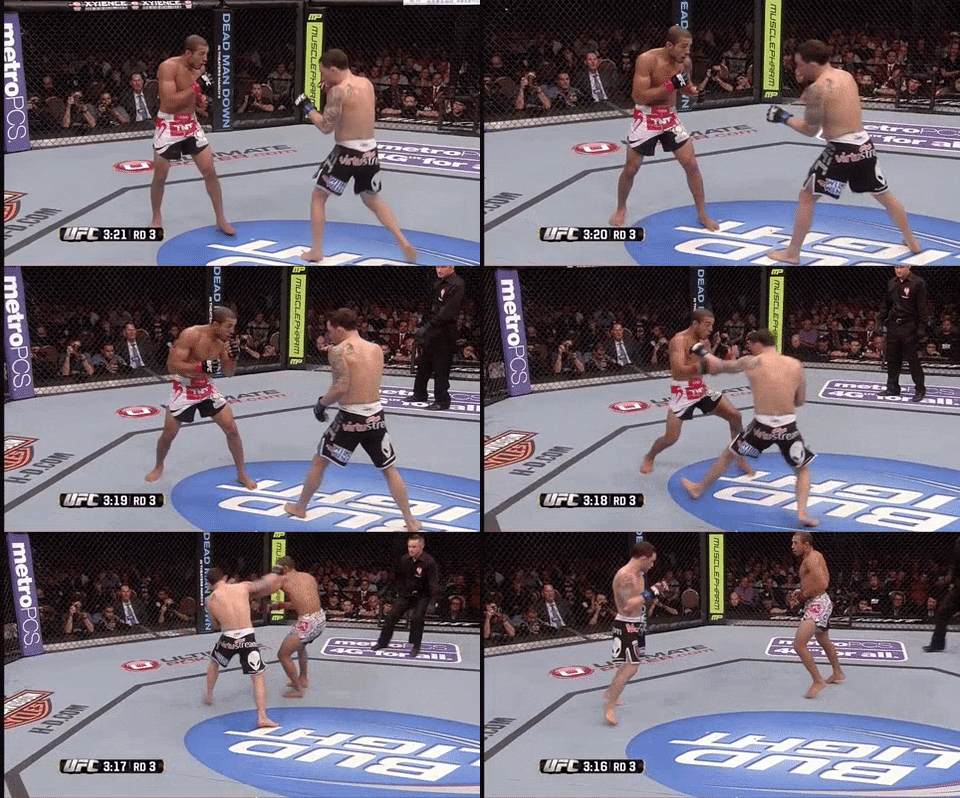
Lead Side Slip -> Pivot (Lead Side) *example, *Aldo example *example
Rear Side Slip -> Pivot  (Rear Side) *example *example

Slip-> Snap Back

Slip-> Bob

Slip-> Lean


Snap Back
Snap Back-> Lean
Snap Back -> Rear Side Lean 

Snap Back-> Slide Step Away


Weave
Weave->Shoulder Roll (or Roll Wth Punch) 
Weave Hook->Roll With Cross *example


I might get rid of parry/block combinations 
Parry
Rear Hand Parry->Lead Arm Cover->Snap Back *example
Rear Hand Parry->Lead Arm Cover->Weave Rear Side *example
Rear Hand Parry->Shoulder Roll 
Rear Hand Parry->Lead Hand Parry->Rear Arm Long Block
Rear Hand Parry->Lead Hand Parry->Rear Hand Cover *example


*R. Front Cover->Shoulder Roll->Cross …*Example


Reference
https://evolve-mma.com/blog/4-head-movement-techniques-for-boxing-and-how-to-train-them/

https://www.youtube.com/watch?v=HVTTZI_7Lvw

https://blog.joinfightcamp.com/training/3-drills-to-get-better-head-movement-in-boxing/


https://youtube.com/shorts/Xt3IEB3Ses8?si=NyEx0S_J499CsrNf

Lean

Lean - I don't think there is an actual common name for this, so I just came up with the term lean. This is something I've seen fighters such as Dominick Cruz and Jeff Chan do. Essentially you are moving your head away from incoming strikes by bending at the waist and stepping to the side or (more often) diagonally back. Your shoulder generally lined up between you and your opponent. In some ways it is like an exaggerated shoulder roll which incorporates footwork. 


-Lead Side Lean (Crouch) 
-Rear Side Lean (Crouch) *example

Exiting Footwork From Lean
-Rear Side Lean Step Away *example *example 
-Lead Side Lean Step Away *after cross (dart) example

Monday, October 6, 2025

Blocks/Covers/Parries/Catches (Counter Attack)

Left Lead
Parry Series (Hand & Forearm)
Right
2. Right Hand Parry->Right Hand Counter *Against a jab (cross counter) *Against a jab

Left
1. Left Hand Parry->Right Hand Counter *Against a cross
2. Left Hand Parry->Left Hand Counter *Against a cross *Against a cross

-Can be done with or without footwork. 
-See slip series for options that include slipping. 

Front Cover Series
Right 
1. Right Cover ->Left Hand Counter
2. Right Cover-> Right Hand Counter

Left
1. Left Cover->Right Hand Counter *Against a cross
2. Left Cover->Left Hand Counter

Both (Double Pillars)->Left Hand Counter *Againt a cross
Both (Double Pillars)->Right Hand Counter

Side Cover Series
Right
1. Right Cover ->Left Hand Counter *Against a jab
2. Right Cover->Right Hand Counter *Elbow counter strike

Left
1. Left Cover ->Right Hand Counter *Against hook *Against a hook
2. Left Cover->Left Hand Counter

Long Block Series
Right
1. Right Block & Left Hand Counter (Interception) *example

Shoulder Roll Series
1. Shoulder Roll->Right Hand Counter

Body Side Cover
Right
1. Right Cover->Right Hand Counter

Left
1. Left Cover->Left Hand Counter

Dutch Block
Right
1. Dutch Block Right->Right Hand Counter *Against Round Kick *Against Round Kick
2. Dutch Block Right & Scoop Catch -> Left Hand Counter *Against Round Kick

Left
1. Dutch Block Left-> Left Hand Counter *Example
2. Dutch Block Left & Scoop Catch -> Right Hand Counter 


Body Side Cover and Under (Shelf) Catch
Right
1. Pull Leg to Other Side -> Right Hand Strike *example
2. Pull Leg to Other Side -> Sweep *Saenchai example

Left
1. Pull Leg to Other Side -> Left Hand Strike
2. Pull Leg to Other Side -> Sweep

Over Catch Round Kick to the Body
Right
1. Catch with Right Arm -> Left Hand Counter *example
2. Catch with Right Arm -> Left Leg Kick *example

Left
1. Catch with Left Arm->  Right Hand Counter ->Throw Leg to the Side *example *example
2. Catch with Left Arm -> Right Leg Kick *example *First One
3. Catch with Left Arm -> Right Knee *example
4. Catch with Left Arm -> Right Leg Kick Sweep *example *Fourth One

Catching Straight Kicks to the Body
Right


Left
1. Catch with Left Arm->Pull Leg To Left-> Left Hand Counter *example
2. Catch with Left Arm->Pull Leg To Left->Sweep *example


Blue - Secondary/Advanced

Core Counters: Evasions (Counter Attack)

Evasions
Slip Series (Left Lead)
Against Straight Punches
Right
1. Slip Right->Right Hand Counter *Against a jab *Against a jab
2. Slip Right & Left Hand Hit->Right Hand Counter (Interception) *Against a jab *Against a jab
3. Slip Right->Left Hand (Jab) Counter 

Left Side
1. Slip Left->Left Hand Counter *Against a cross
2. Slip Left & Right Hand Hit->Left Hand Counter (Interception) *Against a cross *Against a jab (cross counter) *Against jab *Against a jab *example
3. Slip Left & Left Hand Counter *example *uppercut counter

-Can be done with or without footwork. With or without parry. 
-Generally slipping to outside of opp. punch but can also slip inside
-Slipping Inside (Left) of opp. jab and simultaneously throwing an overhand is sometimes referred to a cross counter. 

Bob Series (Left Lead)
Right
1. Bob Right->Right Hand Counter *Against a jab(uppercut counter) *example
2. Bob Right & Left Hand Hit->Right Hand Counter (Interception)
3. Bob Right & Left Hand (Jab) Counter

Left Side
1. Bob Left->Left Hand Counter
2. Bob Left & Right Hand Hit->Left Hand Counter (Interception)

-Can be done with or without footwork. With or without parry. 
-Generally slipping to outside of opp. punch but can also slip inside)

Weave (Roll) Series (Left Lead)
Right
1. Weave Right->Right Hand Counter *Against a hook
2. Weave Right & Left Hand Hit->Right Hand Counter (Interception) *Hit the body  *Hit the head

Left
1. Weave Left->Left Hand Counter *Against a hook
2. Weave Left & Right Hand Hit->Left Hand Counter (Interception) *Hit the body  *Hit the head

-Can be done with or without footwork.

Snap Back/Pull Back (Left Lead)
1. Snap Back->Right Hand Counter *Against a jab *Against a jab
3. Snap Back & Left Overhand (Interception) *Example

Lean Back With Simultaneous Hit (Hang)
Right
1. Lean Right->Right Hand Counter
Right Diagonally Back  
2. Back Foot Diagonal Step Back and Opposite Hand Overhand/aka Hang (Interception) *techniqu

Left
1. Lean Left->Left Hand Counter *example(between a weave and a lean)
2. Front Foot Full Diagonal Step Back and Opposite Hand Overhand/aka Hang (Interception) *technique *technique *example

Lead Foot Step Back
1. Step Back->Oppostie Leg Rounk Kick *Against Low Rounk Kick
2. Step Back->Cross *Against Low Round Kick