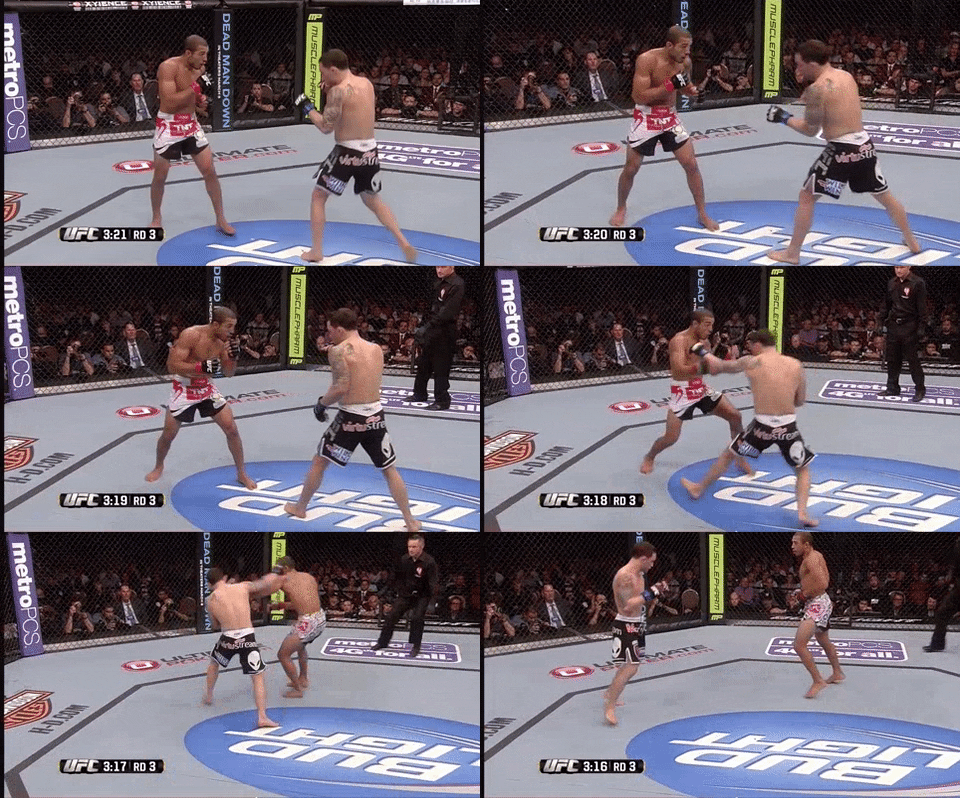
What is a martial art?
I've been doing this martial arts thing for a number of decades now. So what aspects of it do I think (or think I think) are the most important to me? Listing them in my perceived order of importance, I believe it is:
1. Self-defense
2. Physical fitness
3. Psychological/mental benefits
4. Competition (nonsporting)
5. Social Connection
The point of this little thought exercise is to try to provide a kind of foreword to these notes. To help explain why I included the material I've included and excluded or minimized other material. In particular you can see that I prioritize, self-defense over sport competition (which isn't even listed).
Though there is a great deal of overlap between the two, there are also major differences. These differences influence both the techniques you choose to focus on and the time you commit to them.
In contrast, during a self-defense encounter, it’s highly unlikely your opponent will be a skilled grappler. Most untrained individuals won’t intentionally go to their backs to play guard because they don’t know that position exists as a tactical option. Even if you do end up there, the fundamentals learned in your first six to eight months of BJJ are usually sufficient to escape and establish a dominant position. Add strikes to the equation, and breaking open the guard becomes even easier.
The challenge is that you cannot train the guard in isolation. To truly understand how it works, you have to practice it against opponents who are resisting. That kind of live training means sparring. Once you introduce sparring, you inevitably need to include some guard-passing instruction. Without it, your students would struggle endlessly in training, stuck in stalemates with partners who know how to hold the position. So, even though guard passing itself may have limited application in a real fight, teaching it becomes necessary to make the overall guard training functional and realistic.
This same logic applies elsewhere in the curriculum. When preparing for self-defense, it makes sense to devote significantly more time to defending against punches rather than kicks, simply because punches are far more common in street encounters. Kicks aren’t ignored, but they’re treated as secondary—a smaller part of the overall training. The goal is to structure instruction around realistic priorities and scenarios: practical foundations take precedence, but completeness isn’t sacrificed.
So does this mean at the end of the day, your ground curriculum is just sport jiu-jitsu techniques? I think if your focus is self defense you have to teach a well rounded curriculum, including some techniques which a student may have no use for in a real life confrontation, if it is necessary to further their competency in more useful areas. It is necessary to teach guard passing so that students have further their guard skills, but knowing that it is less useful in a self defense encounter means we would train it less than what you would find at a typical BJJ school. There are many areas of the curriculum where this shift in time and emphasis would occur. For instance, I would emphasis punch defense way over kick defense, since punches are far more likely in a street defense. This doesn't mean I eliminate them from the curriculum. Just that less time would be spent on training them.
-----------------------------------------------------------------------------------------------------------------------------
Section II expands on basic offensive strikes, while Section III develops the defensive tools. In both sections, you'll find what I refer to as core techniques. These core techniques are composed by integrating the individual elements from Section I—much as simple components join to form larger, functional units. By practicing these combinations, you move from isolated basics to fluid, effective movement patterns that can be applied in real sparring or self-defense scenarios.
These core techniques are by no means the entire story. ...